





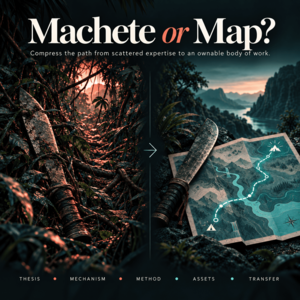

Thought leadership needs an organizing principle.
Not a topic, but a thesis.Most expert-founders don’t have an idea problem. In fact, they have too many! (I relate)
What we have is an organizing problem. Years of experience produce hundreds of observations, frameworks, stories, methods and opinions.
But until those ideas are consolidated around a handful of big ideas, the work can still feel fragmented.I normally push founders to identify around 10.
Not because 10 is magical. Or even scratches the surface of what you know.
But it forces the question:What do I believe strongly enough to keep building around?
The best big ideas usually have at least one of these qualities:
They have momentum – they help you play an infinite game.
They have relevance – they speak to something people urgently need.
They have timelessness – they remain useful beyond a trend.
Or they have contrarian tension – they challenge the default way of seeing something.
Once those ideas become clear, it’s easier to do a lot of work downstream.
Sharpen your brand pillars.
Clarify who your ideal clients are.
Give your content recurring territory.
Inform your products and offers.
Strengthen your messaging.
Guide collaborations and promotions.
And eventually create a recognizable content matrix that communicates your body of work.
You stop asking, “What should I post about?”
And start asking:“Which of my ideas does this help deepen?”
Those 10 big ideas then sit beneath your umbrella thesis. Ready to be pondered.
------
Here are mine:
Tomorrow's breakthroughs in human flourishing are hidden in today's expertise.
Much of the valuable intelligence in human potential, performance, and wellbeing remains tacit – embedded in experience, intuition, judgment and patterns that haven’t been made visible.
The opportunity isn’t simply to share what they know, but to apply the value into something the world hasn’t seen yet.
- Sense before you solve. The quality of the solution rarely exceeds the quality of what is able to be sensed. We disproportionately favor logic, speed, cognition and action when we solve – often leaving perception, intuition, and what our embodied experiences need off the table.
- Start with your MVX (Minimum Viable Expertise). Before you scale the whole product ecosystem, prove the smallest expression of your expertise that creates disproportionate value (to avoid creating an offer monster!).
- A body of work starts with a philosophy. Your collection of tools, models, and exercises isn’t a body of work. You need a point-of-view, a hypothesis, and a set of beliefs or truth filters that anchor the work.
- The most valuable knowledge is often tacit. Your greatest intellectual asset may be what you inherently know but haven’t made tangible yet because its so implicit to your day-to-day work.
- Expertise becomes more valuable when it stops depending on the expert. The real opportunity is to go beyond access to your time – and create new value that no longer depends (only) on you to deliver it.
- Great methodologies are often discovered, not invented. Discovering the system already hidden inside your work is about uncovering the patterns already embedded in years of practice. Extracting it is fundamentally archaeological.
- Turning pattern recognition into pattern creation is a separate skill. The highest form of mastery isn’t knowing more information, but seeing something others don’t see yet and giving that pattern a form. Knowing how is its own expertise.
- Productization stems from an organizing principle or insight. First we must understand the essence of the value before determining the best container to put it in – otherwise we’re swayed toward predetermined formats or mechanisms.
- In a world of abundant knowledge, embodied discernment becomes scarce. AI makes creation cheaper – whereby making our waning human abilities to sense, perceive, intuit, and discern more valuable.
- Expertise is an overlooked source of venture origination. The best ventures may also begin with an expert’s discovery, not a only startup idea operating around a problem. Exceptional expertise isn’t only a service asset, but possible venture material