.png)





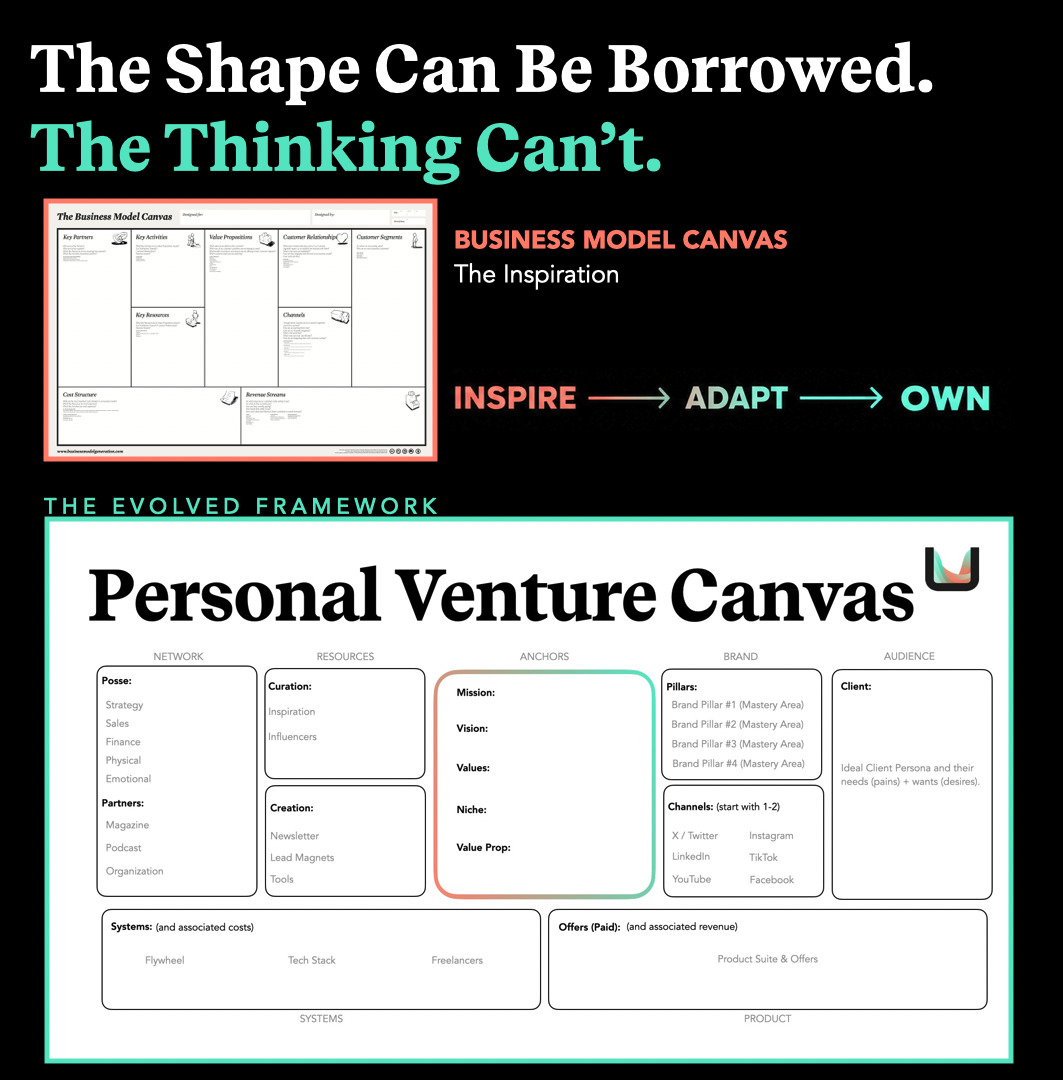

Make Your Best Work Mappable
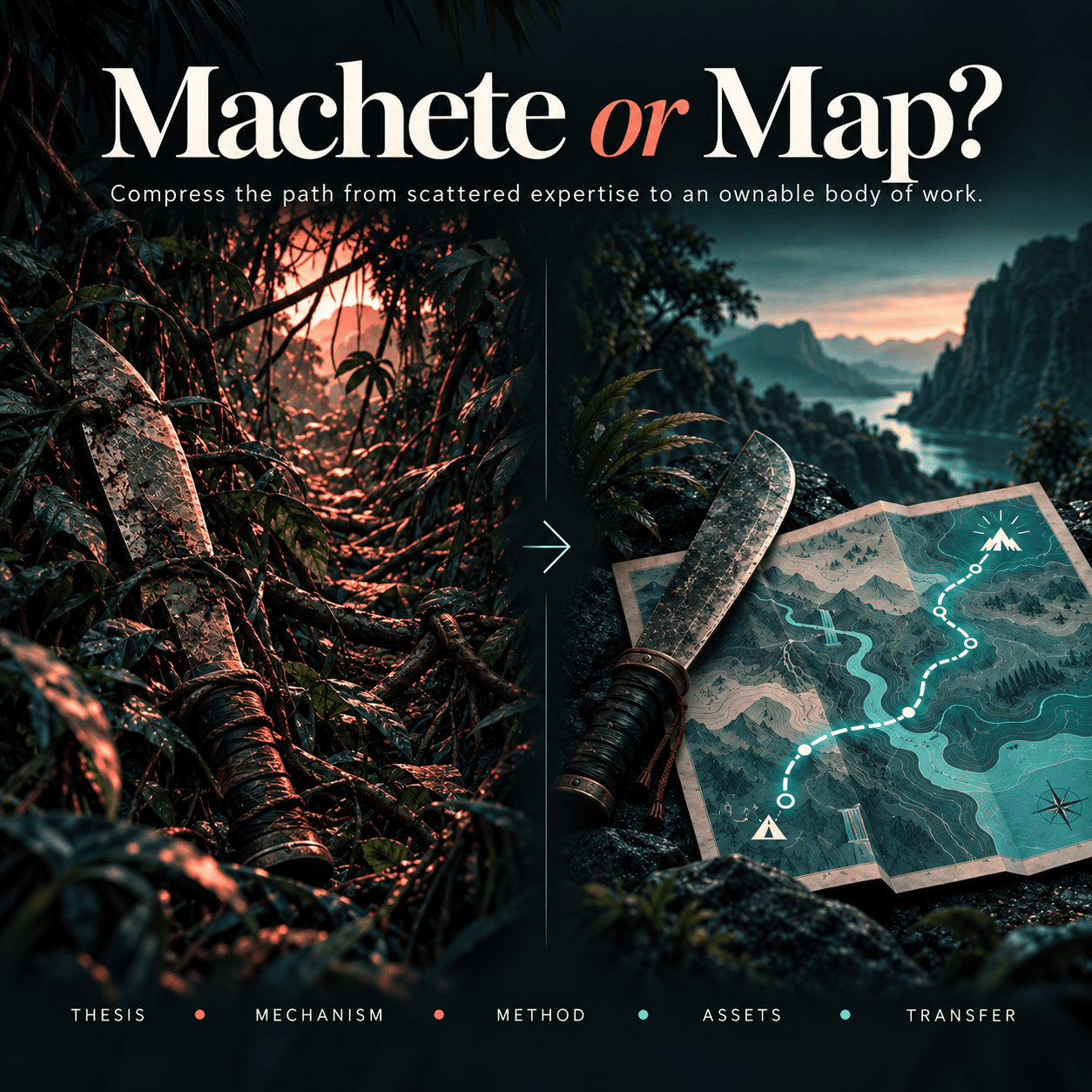
Continue using your machete getting through the jungle…or use a map??
(Well, ideally, both)
Turning the mastery that currently lives in your head, your delivery, and scattered assets into an ownable body of work your clients can recognize can feel like trekking through the jungle with no clear path. Wouldn't everyone prefer a map so your clients can have agency to navigate their own experience, your team can build from alignment, and your business can grow around a clear organizing principle.
In a nutshell, it’s the ability to be able to answer these questions with clarity and conviction:
Thesis: What do I uniquely believe?
Mechanism: What evidence exists that it works?
Method: What do I repeatedly do that gets the desired result?
Assets: What makes the method visible and usable?
Transfer: Can someone (or something) else create (part of) the result without me?
Easier said than done! A lot of experience is hidden within these questions.
At the moment, I’m researching 100 genius systems intuited by their creators, some taking 20+ years to develop.
But if you zoom out far enough, they were basically able to answer these five questions with clarity, conviction (which comes from the evidence that emerges from consistent trial-and-error over the years), and a sophisticatednuance.
That timeline can be compressed. It’s like being handed the option of hacking through a jungle with a compass vs. a map.
Until you can answer those questions above and map out your body of work:
- Your best thinking stays trapped in delivery.
Clients still need access to you to get the full value of what you know. - Your team keeps relying on your direction.
They can fulfill tasks, but they don’t have a clear body of work to build decisions, content and client experiences around. - Your marketing keeps flattening your expertise into a category.
Leadership coach. Performance expert. Neuroscience consultant. You know your work is more distinct than that, but the market can’t see it yet. - Your ideas keep showing up as fragments.
A great model here. A useful tool there. Smart content everywhere. But nothing coherent enough to become recognizably yours. - Growth feels riskier than it should.
Bringing in a marketing team, building new products or using GPTs just amplifies whatever is already there. If the thinking underneath is fuzzy, you get a louder fuzzy version. - You stay valuable because of your availability.
Which means the business can keep making good money while quietly keeping you stuck inside it.