



.png)


You don’t need to reinvent the wheel to create a framework.
Some of the best frameworks I’ve created for clients start by noticing the shape of something that already works.
It’s about looking at the layer underneath the content or even context, and mapping the shape of how elements interact.
These help structure thinking (and grokking):
A canvas.
A matrix.
A cycle.
A filter.
A ladder.
A spectrum.
A decision tree.
And quite often, the best inspiration even comes from an adjacent world or niche.
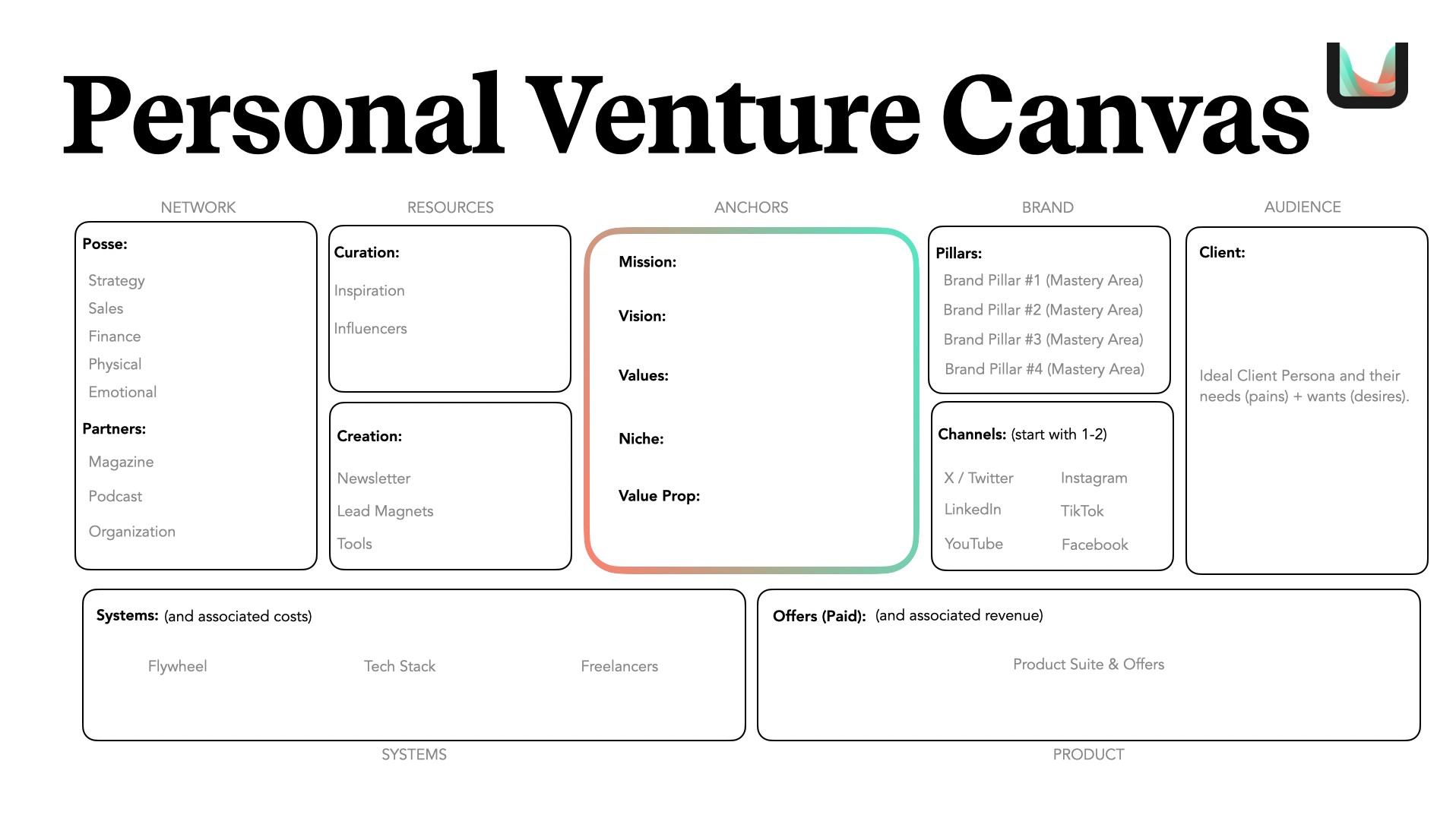
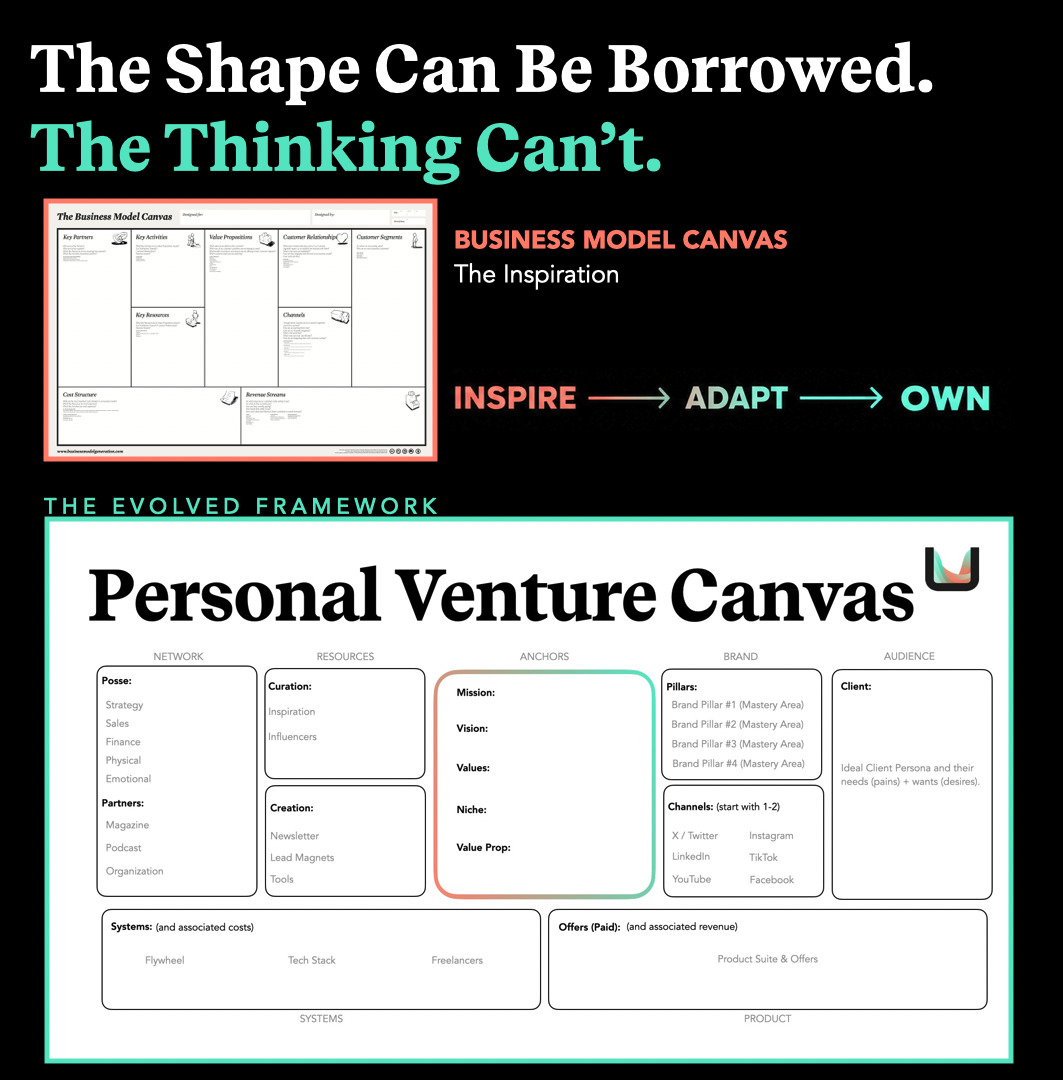
One of mine is the Personal Venture Canvas: used to capture and evolve the business model of a personal venture. I
nspired by Alexander Osterwalder's Business Model Canvas (BMC). Having worked with the BMC routinely since about 2010 while working as an innovation strategist with brands, this framework was already embedded in the way I saw things. Without the need to reference the framework after repeated use, I could naturally extract or compress the same structure for a different context. Hence, PVC was born.
The traditional business model of a solo founder might seem simple, but when you zoom in on the ‘inputs’ and ‘outputs’ that flank a clear value proposition, then new components start to form to help answer:
▪️ What are you building around?
▪️ Who needs it the most and why?
▪️ What resources and relationships support you?
▪️ How might you refresh your content engine?
▪️ What do you want to create to fit your style?
▪️ Where do you want to express your POV?
▪️ What’s the minimum viable supporting infrastructure needed to support you?
Captured easily in a Personal Venture Canvas: a one-page snapshot of the founder + venture system, designed to create enough clarity to test the next move without being fixed.
Similar to the BMC, it becomes a single snapshot to hypothesize scenarios by changing up boxes or quadrants.
A helpful conversational tool during a build, iteration, or pivot.
That’s the part I think people miss when creating proprietary frameworks.
Originality doesn’t require inventing a completely new shape.
Originality comes from taking an elegant structure, understanding why it works, and applying that logic to a problem it wasn’t originally designed to solve.
Creativity might be the pursuit of originating something new, but innovation is the habit of refreshing thinking or changing behavior with impact.
What is a framework that has been so embedded in your psyche that it becomes a go-to tool in your work without thinking?