





Flowability: the missing question in MVP design
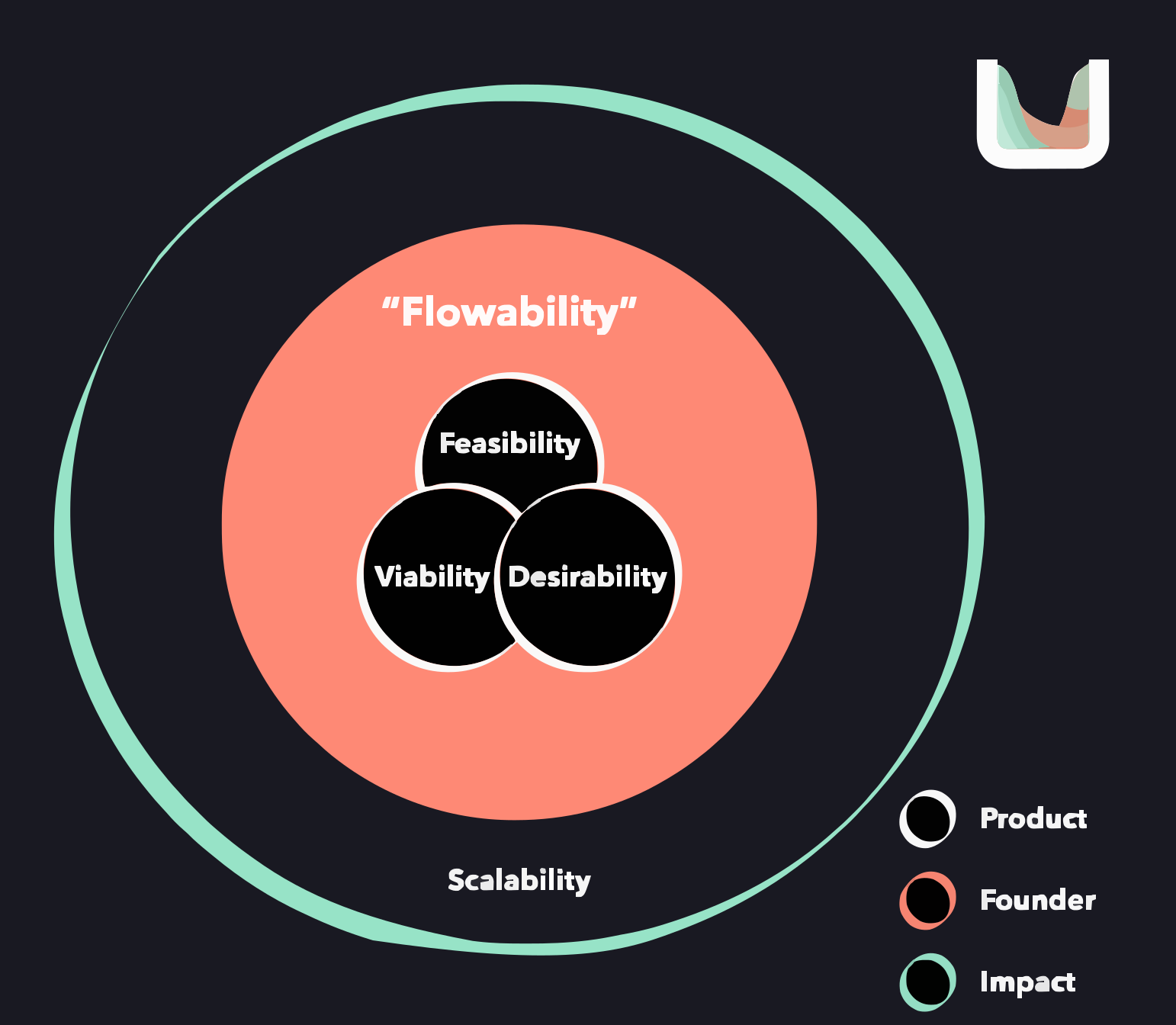
When we evaluate a new venture, we usually ask three familiar questions:
Is it desirable?
Do people want it?
Is it feasible?
Can we build and deliver it?
Is it viable?
Can it work as a business?
All essential.
But for founder-led ventures, I think there’s another question sitting around them:
Is it flowable?
By flowability, I mean:
Can the founder bring this idea to life in a way that supports repeated access to focus, energy, creativity and meaningful challenge over time?
Because an idea can be desirable, feasible and viable – and still be a terrible venture for the person building it.
The market may want it.
The economics may work.
The capability may be there.
But if the founder has to continually override their temperament, values, energy, attention or preferred way of working to keep it alive, the model is fragile.
The litmus test for that is "flowability" – wrapped in a broader layer of sustainability.
Not sustainability in the environmental sense.
Sustainability of the founder-venture system.
Can this venture keep generating energy as it grows?
Can the founder stay close enough to the work that gives them energy, while designing systems around the work that drains it?
Does the business create the conditions for deep work, useful challenge, autonomy, recovery and continued learning?
Or does success simply create a larger machine the founder no longer wants to operate?
This matters especially when we’re building around expertise.
The goal isn’t simply to find something you can sell.
It’s to design something you can keep becoming through.
That shifts the MVP question from:
“Could this work?”
to:
“Could this become a game I’m willing to keep playing?”
Desirability, feasibility and viability can tell you whether an idea has potential.
Flowability helps tell you whether that potential is sustainable through the person responsible for realizing it.
And that may be the difference between building something that works for a few years…
and building an infinite game.